
On Sunday, October 28, Barrett (Barry) Schreiner invited us to consider the value of what the book of Revelation might have to say to us today. With moments of good humor, he took us through an examination of Revelation 18:1-24, and Revelation 21:1-7, 22-27.
With its psychedelic visions and violence, the Book of Revelation doesn’t seem to fit the rest of the New Testament. Despite all the oddness, revelation pops up all over within our culture. It’s been used and abused. It’s usually grossly misunderstood and misinterpreted — though we owe it to ourselves to not simply ignore it. Yet it can also be one of the most interesting, theologically profound and spiritually fulfilling parts of scripture. It can be one of the most important texts in scripture for helping the church to understand theologically the current situation in America.
Barry first gives some background about the book to give us some context, and to help us to see what’s going on in it — with a view that the prediction of future cataclysmic events was not the intent of its author. John instead was addressing the concrete, historical situation of Christians in the Roman province of Asia toward the end of the third century, bringing them a divine word that would help them respond to their situation in a way consistent with God’s purposes. Yet like all scripture, Revelation continues to speak to all of its readers, continues to speak to the church today.
Next Barry discussed the Babylon and New Jerusalem passages mentioned earlier. Though hard to hear, the passage regarding Babylon is a powerful condemnation of the Roman empire, the idolatry it demanded of Christians, and the brutal system of economic exploitation at its foundation. It speaks as well against all similar domination systems throughout history, including the one we live in, the American empire. It also exhorts followers of Christ to avoid complacency and complicity with them.
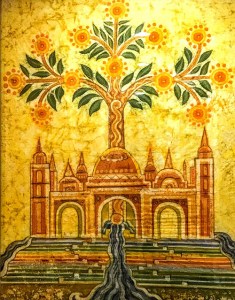
One of the many interesting aspects of the book is the intentional contrast between Babylon and the New Jerusalem, the holy city coming down from heaven. The New Jerusalem passage encapsulates our hope as Christians, but at the same time is an exhortation to the followers of Christ to reject the idolatrous life of Babylon and to live as if the New Jerusalem were already here.
So how do we do that? How do we live that way? Revelation uses the imagery of conquering — yet is a call to conquer in the way that Jesus conquered: through persistent love and self-suffering. We live as if the New Jerusalem were here and now by embodying Jesus’ way of creative non-resistance to the ways of empire and any similar domination system.
Barry explores each of these ideas with thoughfulness and depth. Hear more in the podcast available below.
Hear in more detail here:
For convenience sake, there is also a podcast available. You can find that here.
Image: “The Holy City” by Thetis Blacker, photographed by Patrick Comerford in the Royal Foundation of Saint Katharine.


 Pasadena Mennonite Church