
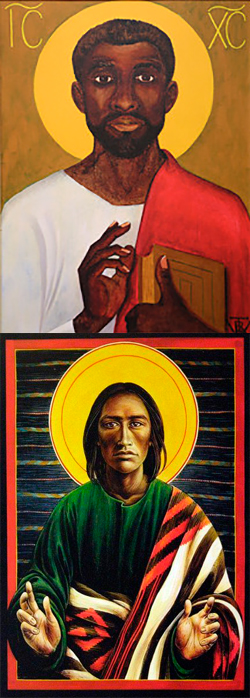
On our annual Thanksgiving potluck Sunday, Tim offers us a close look at the Emmaus Road story from Luke 24:13-35 — which culminates in the breaking of bread in a meal. He starts with an invitation to reflect on: what keeps us from seeing Jesus? what Jesus are we seeing? why does Jesus appear in the breaking of bread?
The passage opens with two disciples walking away from Jerusalem toward Emmaus. These are people who’ve been loyal to Jesus, who’ve followed in his ministry, and marched to the capital city of Jerusalem as Jesus declared a new kingdom — ultimately leading to his execution. They have put all their hope in Jesus, Messiah — yet now are marching away from those hopes. They are marching away from the community of Jesus followers. They are disappointed, and talking about it.
The disciples don’t know about the resurrection — though they’ve been told. They begin telling the stranger they’re with (Jesus) about the prophet that they thought would deliver them — yet fail to see the Jesus in front of them. Though we have the advantage of hindsight, we might ask ourselves if we have disappointment with Jesus — or with God’s action in the world?
The disciples wanted and needed justice — and they weren’t wrong. Jesus had proclaimed release for the oppressed and the captive, and sight for the blind. Jesus came to set up a kingdom, and the issue is not that he hasn’t come to be political — but that he does it so much differently than expected. It’s not a kingdom achieved with weapons, war, and domination — but an other kingdom. The disciples wanted Jerusalem to be liberated now. Rather than a victorious Jesus, they got a crucified Jesus. And not only can the disciples not see, they have a problem hearing. They haven’t heard the women who told them that Jesus was no longer dead, but resurrected. Women who had heard from an angel. Their mindset is keeping them from hearing and seeing. They’ve heard, yet not heard, these things from Jesus as well.
Instead of a king who goes to Jerusalem and battles victoriously, Jesus is one who’s last words on the cross were “Father, forgive them.” Rather than a king who gathers his enemies to destroy them, this is a king who is enthroned in order to offer forgiveness. The disciples are unable to hear other voices.
Tim posits that we too cannot truly see the resurrected Jesus until we can see the crucified Jesus. There’s a disconnect between the king the disciples expect, and the life and mission of Jesus, culminating in the cross. At Emmaus, the disciples couldn’t see the Jesus in front of them because the crucified Jesus isn’t what they were looking for.
Generations of colonial Christians have done the same: crusading and imposing their idea of justice, but not listening. They are Christians who cannot see the crucified Jesus as anything more than a payment for sin — something that happens for me that requires only belief. They see the victorious Jesus as a license for imposing their notions of what justice is on other people, and for justifying their own acts of domination. This is what Kelly Brown Douglas, author of The Black Christ, calls the White Christ: a vision of Jesus imposed by whites in America justifying systems such as slavery by their idea of benefit — bringing civilization and religion to savage people. Frederick Douglass said that Christians were some of the worst slave masters. The White Christ is Jesus focused on victory — skipping his life and identification with the poor, the marginalized and the excluded, and his unjust suffering on the cross — as well as his call to share in life together. It does not challenge power, demanding only that one look inward, caring for your own soul, while blindly following power — and assuming that power is ordained by God.
The resurrected Jesus is always the crucified Jesus — bearing the wounds of crucifixion and the suffering of the world into heaven. According to Douglas, the Black Christ is the Jesus envisioned by slaves, and advocated by later black art and churches: the Christ of Jesus’ life, his unjust death, and intimacy with the poor, captive, and suffering. Jesus’ cross reveals not an act of justice, but an act of injustice based on what the world calls just. It revealed Jesus’ own justness, taking the side of all who suffer. Jesus doesn’t simply submit to violence but attempts to live out God’s just, true kingdom: rejecting domination, overcoming exclusion, challenging oppressive structures; and living into God’s reconciliation, God’s forgiveness, God’s neighbor love that we’re commanded to follow, and peace. For that he is executed. The crucified Jesus is a Christ of identification: on the cross Jesus becomes every person that is marginalized, rejected, excluded, dominated or exploited. Jesus is mocked and reviled, shamed and scorned. And those people that Jesus has identified with are glorified in that act. Jesus becomes king of a new kingdom enthroned in heaven that centers on these. The resurrected Jesus does not leave behind the cross, but bears with him the marks of that crucifixion. Perhaps the disciples were not looking for this Jesus.
Tim goes on to talk about the conclusion of the passage: the disciples invite Jesus in to dine with them. This is a kingdom act, one of intimacy, inclusion, and overcoming boundaries. Yet Jesus becomes the host, and is seen in the breaking of the bread. And as we fellowship together, we are not the host. Instead, Jesus hosts us, guides us and holds us together. Our tables are open to the crucified Jesus and all whom he identifies with.
Don’t miss out — hear in more detail here:
Images: top, Black Christ icon by Rev. Canon Warner Traynham; bottom, Compassionate Christ by Father John Giuliani.


 Pasadena Mennonite Church