
On January 20th, Frank Scoffield Nellessen continued PMC’s theme for the month of first fruits giving. He weaves the theme of giving beautifully with our honoring of the Martin Luther King Jr. holiday. Reflecting also on 2 Corinthians, Frank brings together the words and works of Paul and MLK.
“God’s love is radical, flowing through the radical sharing of time, talents and treasures that Paul and Martin Luther King Jr. testify to today. This love creates a world where ‘the one who has much does not have too much and the one who has little does not have too little.’ Today we can thank God for love flowing through generations of communities, from Corinth to the South to Pasadena, who teach us how to love.”
Frank goes on to say that we need days like MLK day, when we remember a person who led an inspiring struggle of love. And it’s so important to have elders, dead or alive, who teach us love, because so much of our talk about it these days is misdirected, lacks substance, and is purely theoretical.
Sermons, articles and books reflect on love, but if God’s love could be understood with writings and sermons alone, God would’ve just given us the Bible. But God became human. God gave us Jesus. God gave us love to touch, smell, hear and see. Love to walk, laugh and cry with. Love to feel viscerally and know intimately.
But have you ever had a real close relationship to another human or another community? Loving, like, actually loving, is not cute, romantic, and least of all, easy. Loving is hard work.
Paul writes to the Corinthians to “test the genuineness of [their] love,” cause seriously how easy is it to say “I love you,” and how hard is it to live, “I love you?” Paul says he tests them because they know the generous act of Jesus to them. God so loves the world that she shared her Son with us that we would enter her eternal life of love.
So MLK and Paul, two figures who knew God’s radical love, continue sharing it with us. MLK and Paul are very similar after all. These are two men who have shaped the lives of millions over time, whether directly or indirectly, through their writing, witness and work. Many Christians and non-Christians hold up these men as moral exemplars, brilliant intellectuals, and passionate preachers. Their writings and sermons are held as some of the most powerful rhetorical, impassioned and convicting ones. They are nothing short of heroes to people across this country and beyond.
But there’s a problem with heroes that we can’t overlook. On days like MLK day we often forget hundreds of people whose shared life testifies to God’s radical love. MLK day is a significant date. It is rightly remembered nationally as the day to celebrate a great legacy. But we must remember that even celebrations of MLK can be co-opted by powers of individualism and heroism that make him a hero not much different from Spider Man or Batman. Generations of people raised by things like Marvel comics and Superhero movies have made us think that heroes are self-made individuals who come save the day. So the end product of MLK day can be an image of an inspiring Man (emphasis on the MAN), who shows up and saves the day. Talk about patriarchal powers co-opting a powerful legacy. Erased from our memory is the slow, painful, and resilient life of thousands of common people whose “abundant joy and extreme poverty overflowed in a wealth of generosity in the midst of intense affliction,” as Paul says of the Macedonians. And erased from our memory are the lives of powerful women as well.
Paul and MLK were not self-made heroes who should inspire us to do likewise. They were much more simple and much more human than that. They were simply individuals who were birthed, nurtured, educated and sustained by communities rooted in God’s radical love. Paul and King were as human as you can be, often fearful, persecuted, confused, and with more than one questionable belief about things like the place women of women, to put it mildly. But nevertheless they were rooted in communities rooted in God’s radical love whose love flowed in sharing time, talents and treasures.
Unfortunately, remembering MLK as a kind of superhero has erased the radical and difficult sharing of time, talents and treasures among many that made the civil rights struggle a reality. But God’s love flowing through the sharing of time, talents and treasures is more visible through another radical and her community
Ella Baker was a radical organizer during the same time as King. Baker is said to have taken radical democracy among black communities to the next level, particularly with the Student Nonviolent Coordinating Committee. Her radicality, much like Pauls or King’s, was born of communities committed to God’s love, justice and peace.
Her biographer says that Baker was raised by “strong, hard-working deeply religious black people, most of them women.” She grew among passionate and resilient women around dinner tables, living rooms, churches, streets and organizing meetings. These women “sponsored an orphanage, aided the sick and elderly, funded scholarships for black college students and provided aid to local, church-affiliated grammar schools.” They also made home visits to the sick an led small reading groups called Bible-bands, forging personal, cross-class relationships with the poor and illiterate members of their community.” Baker was raised in this context of intimate struggle were the life of church, home and world intersected at every moment
As she puts it herself, “If you share your food with people, you share your lives with people.” And if you share your lives, you share love, grief, laughter and tears with people. When we share food, sorrow and love how can we but share time, talents and treasures. God embraces communities open to her love in ways that never leave them the same. The women who birthed, nurtured, educated and sustained Ella Baker lived in God’s radical love.
Now, the radical sharing of love was not without challenges, as we and the Corinthians know. This radicality is very complex–how much? When? What about others who aren’t sharing? Why am I giving more of my time than they are? They have resources so will giving increase? Why the pressure to give and get so involved? These are common experiences as Paul knew, calming the Corinthians down saying he didn’t “mean that there should be relief for others and pressure on [them].” It’s hard to be drawn into God’s love. Christians through the centuries get it, not least of which are Paul, King, Baker, you and me. In the process of sorting out these challenges, there is strange way in which God’s love is reduced to an obligation, joy to responsibility and delight to duty. God’s radical love draws us into a reality that seems impossible. Can we really love with this kind of radical love?
It is a hard and real question
Generations of Christians will answer with a resounding YES . YES, yes it is possible. It’s hard to let God’s love flow through our radical sharing of time, talents and treasures.
Paul, King, and Baker all knew the challenge of love, as do we. But they also knew the possibility, the practicality, the realistic nature of love. They had seen love in elders refusing to give in to hate even when that seemed like the best option. They had touched loved in mothers who bandaged their wounds as children and held them against their chests in marches and protests. They had smelled love in kitchens flowing with the scents of freshly cooked food for the church member who had just had a baby or lost a loved one. They had heard love in the cries of mothers over dead children and the laughter of enemies reconciling. The love of God is felt in the most embodied and visceral of ways. Love is felt in the everyday intertwined with every struggle. God’s love is an idealistic possibility to those detached and distant from communities rooted in radical love .
Sharing time, talents, and treasures is the only thing that makes sense when the radical love of God has taken hold of you. Once you’ve felt the sound, touch, sight and smell of brothers and sisters’ suffering and love, what else could you do?
Hear these words and more in Frank’s moving voice:
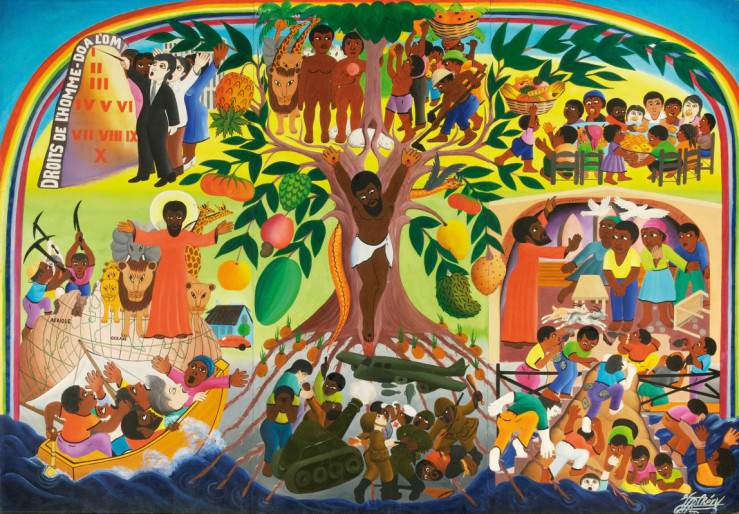
Image: Jacques-Richard Chery: The Tree of Life, 1982. Acrylic on cloth. Misereor Lenten veil.


 Pasadena Mennonite Church