
On January 27th, Lisa Danner continued PMC’s January theme of giving.
Lisa anticipated that speaking about giving would be an interesting challenge, because money is a complex issue for her personally.
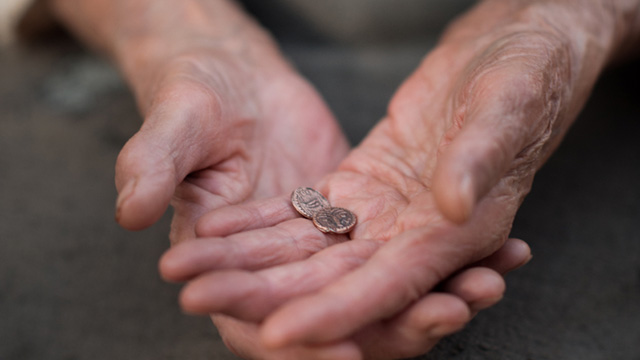
Even so, she thinks it’s important to talk about our giving because, in a consumer society, the way we interact with money—what we decide to give, to spend, where to spend—requires frequent decision-making. And the way we interact with money is a moral decision. Though giving is much broader than monetary giving, we have had sermons on other ways to serve or share resources and talents recently. And the focus on money is also because the widow in our passage—Luke 20:45 – 21:4—gives money specifically and Jesus comments on that.
How many of us were told by parents or elders that it’s rude to talk about money? Lynn Miller has a great anecdote about this in the beginning of his Firstfruits Living book, where he recalls being a journalist covering a meeting for a group that was planning stewardship education, where their task—this was 1986—was to develop strategy for the denominational goal of “Every Member Adopting a Modest Living Standard.” He said their discussion was spirited and inspired, but, as he began to inquire about exactly how much in dollars a modest living standard was, he discovered that they could not be specific. They all agreed that a million a year was far too high for one person annually, but as he went lower, it was as if, Miller writes, “the trigger of a fire extinguisher had been pulled, [and] the flames of enthusiasm for defining modest living standards diminished. ‘But surely,’ [Miller] persisted, ‘we as the church can speak to the church in very specific terms about how much is too much.’ ‘Oh no,’ insisted the protestor. ‘It’s up to each person. It’s a private matter, a matter between each Christian and God.’”
These private and public domains of money are very interesting. We are bombarded in advertising by images of over-the-top indulgence, and in media we receive more subtle messages that can be just as indulgent. Watch the documentary “The Queen of Versailles” for a remarkable look at how damaging consumerism is to the psyche.
In our culture we have lots of representations of wealth, and people interacting around the dream of being rich. But alongside extreme wealth, and much more common in our actual society, are people in desperate need. If you work with low resource communities, or even if you just walk through urban areas in LA, you encounter this reality. Each extreme makes the other end look more absurd than it already is.
In Luke we see these two poles as well. We see the teachers of the law first, strutting around in their robes and making a show of how much they can give. And then right after that we see the widow, who gives two small coins. She gives all she has to live on, and Jesus notes there that she has given more than these rich men.
It’s pretty easy for us to see that the widow has given more. Whereas the lawmakers miss nothing after what they give, she gives all she has at that moment. It also seems that, despite how consistently the Gospel reveals the trap of wealth and the ways it distances us from God and other people, the world is always going to celebrate the bling. Christians aren’t exempt from this. Is it even possible to become extremely wealthy without exploiting people somewhere along the line?
What’s not resolved in the widow’s offering is: what’s important in her giving? Is it that she isn’t attached to wealth? Is it that she has faith and that God will reward her for it? Why does Jesus point her out?
A lot of people have interpreted her significance in light of Jesus’ criticisms of the elitist scribes just before. Because he says they victimize widows—they devour widows’ houses—while they make lengthy prayers. She is the visible victim of their hypocrisy. Other commentators have remarked that the widow’s monetary sacrifice is symbolic of Jesus’s sacrifice to come: she’s giving her whole life with her donation.
Yet there is real power in the witness of a person with no worldly wealth giving what little they have. Generosity, and sacrifice, and faith are not just possible choices for the oppressed, but those who are oppressed reveal those virtues to the wealthy. Many of us have had experiences visiting people who live on very little materially and yet, if we go to their house they treat you like royalty—they give you their one bed or spend what they would normally spend on their food for a week to prepare a feast for you.
But what does sacrifice mean for people who have resources, for people who can’t shed all their privilege even if they tried? This image of a poor widow giving her all can be so distant from who we have ever been it can become a symbol that’s beautiful and holy, but detached from instruction.
Lisa goes on to share her own background with money as a way of illustrating that figuring out what a modest living standard means, and what your financial giving should entail, is contextual. This is probably why it’s hard to give instruction to others, as the young reporter Miller was hoping for, because of all the complex desires and fears that individuals can have around money. For example, Jay-Z and Beyonce make a point of discussing how to build intergenerational wealth in black communities. On their latest album, Beyonce raps, “My great-great-grandchildren already rich / That’s a lot of brown children on your Forbes list.” This just hints at how there are intersectional identities and justice issues that poverty and wealth represent for people based on personal and collective history.
Finally, as much as giving is affected by things that are personal to us, that doesn’t mean our giving has to be private. If our circumstances are nothing like the widow, we need examples and conversation and challengers in life life to share how they think about money in 2019 in California. We can continue to encourage each other to talk about how we use the different resources we have at our disposal, and try to make those conversations safe, but not so safe that we’re not challenged. There’s nothing safe about the widow’s offering. She challenges all of us to examine how we can be courageous with giving.
Don’t miss Lisa’s personal examples for their self-reflection and their humor! Listen here:


 Pasadena Mennonite Church