
On March 3rd, Transfiguration Sunday, Tim Reardon spoke of the transfiguation of Jesus in Luke 9:28-36 as a transition point in Jesus’ ministry. Previously, Jesus had been moving about Galilee speaking about a kingdom, now he tells his disciples he must go to Jerusalem to proclaim this kingdom, and there he will suffer, be rejected by the leaders of his people, and then be killed, rising on the third day.
An aspect of this story present in Matthew in Mark is Peter’s rejection of this idea. You may recall this. “Jesus, this is not how the Christ, the Messiah, is supposed to act. You have a kingdom to set up. Jesus this is hardly an effective kingdom building strategy…” and how does Jesus respond? [get behind me Satan.] We will come back to this.
Of course, there is little sugar coating this statement. Peter expects Jesus to overthrow an unjust occupier. Tim says, “And I gotta tell you. I have this attraction to movies about the Irish Rebellion against British rule, and part of me wants to say… you know Jesus, Peter’s right. I mean don’t get me started on the potato famine.” Yet, Jesus instead calls them to follow his way of peace, which would result in their execution. Jesus calls them to a way of peace and confrontation with the powers that be that signs their death warrant. They might as well just bring their instrument of execution with them.
We often read this metaphorically. What burdens am I carrying that somehow I can call my cross? Yet, Jesus’s cross is not metaphorical. At this point in the narrative, Jesus calls them to literally join him. What would you say? I have no answers for you, but this is a foundational Lenten meditation, a foundational meditation for discipleship. What is it to pick up your cross?
If you want to come after Jesus, you must deny yourself. You must not put yourself, your ideals, your complicity to systems of exploitation, greed, sin, and death, in the center — but glory in Jesus, God’s kingdom, center those the world calls poor and sinner. This is Jesus’s call to discipleship. The Transfiguration centers the way of Jesus, and in Lent we then prepare for the journey.
After this call to carry their crosses, Jesus brings James, John, and Peter, up a mountain for prayer—apparently forgetting that he has just a few verses earlier called Peter Satan.
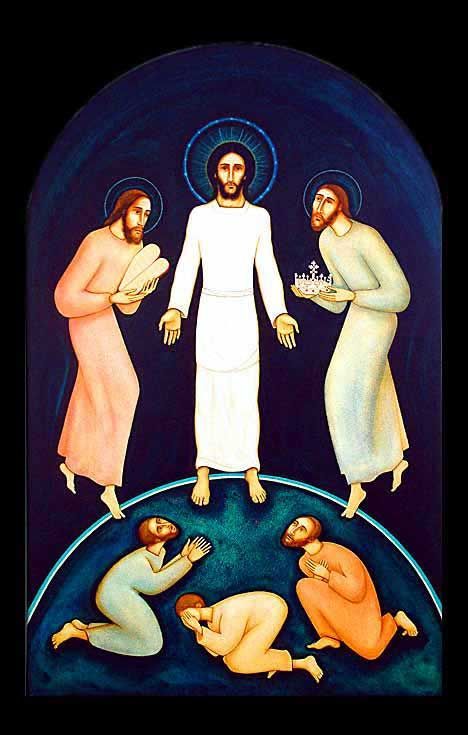
The Transfiguration is a revelation that begins our Lenten journey. It is a revelation of hope for those suffering, who are called to march to Jerusalem, to Babylon, to Rome, to Washington DC, perhaps seeing no hope in their cross marked journeys. Here is a vision of the true structure of the world now and the hope of what is to come.
The incarnate, embodied Jesus is transfigured, and in joining ourselves to this Christ in picking up our crosses, imitating, learning from, putting on, we ourselves become the body of this Christ, citizens of God’s kingdom. This includes his mission of justice and cross-bearing confrontation with the powers that be.
Oscar Romero saw the Transfiguration as particularly important, seeing it as a summation of the Gospel. In fact, he thought so highly of the Transfiguration that he released three of his four pastoral letters as Archbishop of El Salvador on the feast of the Transfiguration. In his last Transfiguration sermon, weeks before he was assassinated, he spoke of seeing in the transfiguration the assurance that the Salvadoran people will rise in glory amid their suffering, that they will join in Jesus’s transfiguration.
Romero speaks in this homily a word to us as well as we prepare for Lent. He says: “Lenton fasting is not the same thing in those lands where people eat well as is a Lent among our third-world peoples, undernourished as they are, living in perpetual Lent, always fasting. For those who eat well, Lent is a call to austerity, a call to give away in order to share with those in need. But in poor lands, in homes where there is so much hunger, Lent should be observed in order to give the meaning of the cross to the sacrifices that is everyday life. Not as a resignation. God does not want that. Rather, feeling in one’s own flesh the consequences of sin and injustice, one is encouraged to work for social justice and a genuine love for the poor.” The transfiguration is hope for our transfiguration, and a call for the journey.
Romero maintained that key element of the Lenten journey and the Transfiguration revelation that is called upon all people is repentance.
The repentance that prefigures Lent is not wallowing in guilt. Nor is it simply words. It is not a cheap repentance. Rather, positively, it is about turning and working to put things right—about reconciling all things, conforming all things to God’s vision of kingdom justice and peace, or new creation. Repentance requires that we, especially those of us with power, decenter ourselves.
Confronting those things that need repentance can be painful, those things that we participate in, often unknowingly, that spread hurt, pain, and perpetuate systems of exploitation. These things must be crucified. The world needs this sort of repentance. Repentance is the work we do by God’s grace to conform to God’s jubilee kingdom.
As Tim continues, he asks us how we might at times take on the role of Peter in having a “better way” than the cross:
Let me put it another way as we prepare to enter into Lent: Are you Peter? Peter hears Jesus speak of the way of the cross and proclaims, “No, Jesus. I have a better idea, a more effective idea, a better system or plan. You seem to not understand.” Maybe you think, O modern that you are, “Jesus, you stick to the religious stuff. I can handle the rest.” But remember, centered with Jesus are the poor, captive, and dispossessed.
Hear in more depth in the sermon recording:


 Pasadena Mennonite Church