
Tim Reardon continued his talk about Creation on November 3rd, preaching from Genesis 2:1-4 and Luke 13:10-17. We don’t have audio for this sermon, and so are sharing the sermon in written form.
Two weeks ago, I spoke about the “Creating God,” the God that forms us and all Creation out of the TAHU VABOHU, the formless void, the chaos. Today, however, rather than talking about “the creating God,” I want to talk about, “the resting God.” I want to move from the beginning of this Creation story to its conclusion, to rest.
I tend to be a person who sees forests rather than trees, this has its advantages and disadvantages. I think we all have different ways that we approach the world, but for me, in order to understand the trees, the things that we do, who we are, and where we are going, I need them to fit into a coherent story.
To that end, I think this first Creation story (Genesis 1:1-2:5) is important not so much because it is at the beginning of the book, or that it is first in time, or that it tells us some objective facts about the way the world was created, but because, here, Scripture begins with this concise summary of God, Creation, its source and its end, an all-encompassing vision of who we are, where we come from and where our ends are.
In this chapter or so, we find a lens through which to read all that follows. And so we know, from the outset, that God forms us from the formless void and into a world in which is rightfully at rest together in God. We are on a journey with all Creation, seeking our Sabbath rest.
When I say Sabbath, what does that bring to mind? Many often imagine Sabbath as an antiquated ritual, a time of personal rest to squeeze in…if we can, or even an obstacle to utilizing our precious time for productivity. However, I think this vision misses the point. Sabbath is not simply an obsolete ritual to tack onto our week or even at best a way to get some rest to charge us up for another week of anxiety and productivity. Rather Sabbath is the goal of all Creation. It is the rest that all Creation longs for. The Sabbath is not an appendix, it is the conclusion to which all builds and shapes the rest of the story.
So as we think today about God’s rest, the question in the back of our mind will be, how are we preparing ourselves to celebrate God’s Sabbath? Because, as we will talk about, Sabbath is not simply stopping work, but it is participating in God’s rest, and it is something we do together, so that we only truly experience rest when all can participate together in peace and wholeness.
Imagine the movement of all Creation, summed up in the first week. All Creation, ordered out of nothingness, life made and declared good, Creation loved, seeking to find its rest in God, the goal of all Creation.
We are in the middle, between the space of God’s creating, overcoming the violence that wishes to return us to chaos and nothingness, on the one hand, and the final rest, on the other. Thus, the creating God is also the resting God, and it is this constant cycle of Creation that we remember in the regular remembrance of Sabbath.
Abraham Heschel wrote, “To observe [the Sabbath] is to celebrate the creation of the world and to create the seventh day all over again. … a day of rest and freedom.” The weekly rhythm is a reminder of our journey and our hope. Sabbath is the participation in our hope now, our anticipation of coming rest for all Creation, and Sabbath is not simply a respite from our week; rather, our week is a preparation to participate in Sabbath.
Now I hear some people say, “well Jesus abolished the Sabbath right, he told us we can work on the Sabbath”—Rob! Did Jesus abolish the Sabbath?!—OK That puts that to rest. I also hear of Sabbath in very personal terms. Have you ever heard this? “I try to get my Sabbath in on Mondays” or I really need to take a Sabbath one of these days, as if Sabbath is about you and recovery to enter back into the rat race.
Sabbath, however, is something that we do together. It requires new relationships of kinship, new ways of thinking our economics, and new ways of practicing our values, and it is this vision that animates our lives in preparation for this rest. Part of celebrating Sabbath is producing the conditions of rest for all, so that our lives are a preparation for ultimate rest.
So what I am talking about is more about Sabbath as a bigger idea. I am not trying to dictate for you a specific weekly Sabbath ritual, this this weekly rhythm itself forms us into people moving toward Sabbath rest. But some questions that come to mind are how are we together living in ways that make it possible for all people and Creation to celebrate Sabbath in rest? How is our community finding ways to participate in God’s rest together?
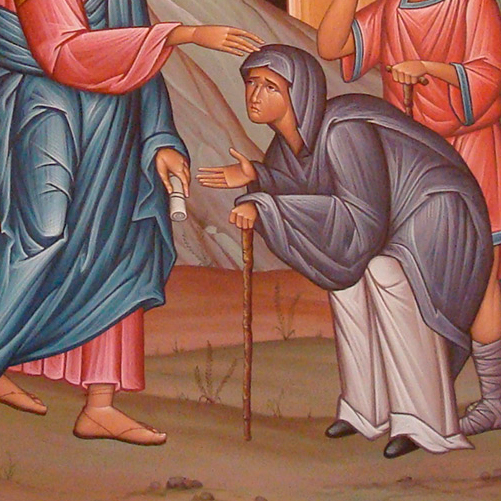
When Jesus, in Luke 13, heals the woman who is bent over in the synagogue, it is not incidental that this happens on the Sabbath. Jesus is creating conditions where this woman too can rest. This is Sabbath practice.
But because it is on the Sabbath, the synagogue leader cannot let it go quietly. He rebukes Jesus for what he sees as “work” on the Sabbath. Just so we are clear, what constitutes “work” on the Sabbath is an open debate. Notice it isn’t that Jesus says, “yes I can work on the Sabbath,” or “but the Sabbath doesn’t really matter!” No! Instead, Jesus says that this is the sort of thing that must be done on the Sabbath—not simply that it can be done, but that it is necessary to free this woman on the Sabbath, because that is what the Sabbath is! A time for freedom, a time for life, and a time for rest. Jesus wants them to think deeper about the Sabbath and what it is for.
So, Jesus turns to the leader, and addresses those with him, “don’t y’all untie your ox or donkey and give them water on the Sabbath, but what about this woman who has been bound for years, does she not deserve Sabbath rest?!”
But looking deeper, there is a fundamental difference between these farm animals and this woman. The farm animals aid in industry, they help produce, but this woman cannot. Her state prevents her from contributing in the same way, and so Jesus here uncovers how they value, and how their way assigning worth (based on productivity) affects even their Sabbath rest.
Let me speak in modern terms, if our economics are based on profit margins over people, if our economic systems form us into people whose moral rule is self-preservation and personal acquisition over communal well-being, kinship, and frankly, Sabbath rest, then we have been formed in ways that make us unprepared for Sabbath rest.
You Are Worth More Than Your Productivity
If the standard by which you judge yourself and your worth is productivity, that is not the standard by which God judges you. That is not the standard by which Jesus judges this woman. With one declaration, “daughter of Abraham” this woman is not imagined in relation to her economic production (as less than farm animals), but her value as family, and simultaneously Jesus calls them to live together differently. The major problem is not her “disability,” but the world’s preference for and organization around those who are “able.”
Who is valuable in our society? How do we see this in the way the world is structured? How do we value the elderly, the differently abled, the refugee? How will we create spaces that work differently, communities that live according to a different rule of life, kinship, equity? How are we preparing ourselves to celebrate God’s Sabbath with all people?
A Personal Sabbath?
Now while Sabbath is not something that we “do” by ourselves, I do think it is something that affects us personally and deeply. Embodying Sabbath rest is shaped by our prayer, contemplation, spiritual disciplines, having a common life together as a community, and attention to the reality of God around us as we gather together. How we are being shaped is immensely important as we seek God’s Sabbath rest. Yet, as we have already mentioned talk of rest can too easily become an individualistic affair.
Now, I might be about to step on some toes here. I often find myself preaching to the choir, but maybe I think I might have found the issue that will make you turn on me: mindfulness. I am not opposed to mindfulness in principle. Mindfulness and contemplation can be a revolutionary practice that changes the way we interact with the world around us. That teaches us an aspect of how to be people of peace within the world, and helps us to pause, reconsider, and reconfigure the stories that we have been told and the anxiety that grips us.
Yet mindfulness in America has become big business—it is an estimated four billion dollar publishing industry, and a primary character of many popular mindfulness teachers is turning inward, isolating the cause of our suffering in our heads. And with this inward turn, these mindfulness teachers pay little mind to and turn attention away from the part external forces or systemic realities play in the anxiety that many experience.
That is why “mindfulness training” is a favorite employee promotion of major companies including many Silicon Valley tech firms, where those working 80 hour work weeks need a plan to de-stress. Coopted by market forces, mindfulness is a means to create workers able to sustain the demands or our progress and market driven world.
As Ronald Purser, author of the book McMindfulness writes “Instead of encouraging radical action, [this sort of] mindfulness says the causes of suffering are disproportionately inside us, not in the political and economic frameworks that shape how we live.” The world we live in has imposed “widening inequality in pursuit of corporate wealth” and we are being taught to adapt. “Stress has been pathologized and privatized, and the burden of managing it outsourced to individuals.” In this neoliberal world, we must simply learn to cope.
This is not the rest we have in Sabbath, a rest that simply helps us cope with an oppressive world. Sabbath is a vision that calls that world into question and demands that we live differently, produce spaces of life that push back against that oppressive world. Sabbath is a rest that is for all people, a rest that transforms all other days, so that every day is moving toward Creation’s rest.
Paul talks about this in Romans 8. Creation is groaning in labor pains longing to find rest, trapped under sin, sin that keeps the world from its rest. This is the story of Creation.
Going back to my sermon from two weeks ago, one hesitation that I have with talking about the “Creating God” is that this God is so easily thought of as the God of production, the God of industry and progress. It lends itself to a bizzaro Creation story, a perverse inversion, where this “creating god” sacrifices all Creation for the benefit of its vision of progress, modernization, and profit, and Sabbath, when allowed, is merely a merciful pause. This “creating god” can seem like an unstoppable force.
But, I think that this Sabbath narrative, the resting God, can offer us a counter narrative. Especially as we see it with Jesus. Jesus’s calls those in the synagogue and us, to value people over production, to promote kinship, and rethink what it means to live into Sabbath rest. And even more than a vision of progress, this Sabbath is a constant reminder of our place in Creation and our deepest home is in God’s rest… not striving, acquisition, or anxiety. Our Sabbath vision is to find ways that we may all rest in God together.
So in conclusion this is an old teaching; it is not new. There is a stream of Jewish and Christian thought that has viewed the seventh day as the archetype for the eschatological vision of the “eternal” day—that one day the world might find its eternal Sabbath rest in God. As we journey together, our weeks are a continuous cycle of remembrance, practicing our preparation to rest in God, seeking the rest of shalom with all Creation. During the week we move together hoping to prepare spaces for one another to truly experience that rest, seeking Jesus’s release. And on the Sabbath we come together to participate in that rest, however, imperfect, inviting all to come together to celebrate.
This has been a sermon more of forest than of trees, but perhaps we can think of ways that we embody this Sabbath Creation vision. We are called to seek God’s rest, and to seek to walk with Jesus who creates the conditions where all can rest. How do we do that? Part of that is our life together, making spaces of rest in common community, and living a different story.
So my somewhat rhetorical questions are, Pasadena Mennonite Church, how do you view Sabbath? How could it animate our life together? How do we live a Sabbath life together? And how do you see us creating a community of rest and Sabbath, of inclusion and release, of new stories and a common “eternal” life?
Though there can be valleys in our journey, I find you, church, to be a place of rest. May we never stop being that for each other and for those around us as we prepare to participate in God’s Sabbath rest together. May we continue to journey the journey of Jesus together into God’s release, where all Creation together can sing praises to God in wholeness and peace.
A benediction from Menno Simmons
All you who have tasted the kindness of the Lord, love Him.
The Lord keeps the upright.
Be of good cheer, and doubt not;
for the Lord will strengthen your souls,
all who patiently wait for His coming.
The Lord reigneth, let the people tremble;
he sitteth between the cherubim; let the earth be moved.


 Pasadena Mennonite Church