
On December 13th, the third Sunday of Advent, Rob Muthiah spoke to Isaiah Isaiah 61:1-4 and 8-11— a passage that finds Isaiah speaking to the people of Judah exiled in Babylon.
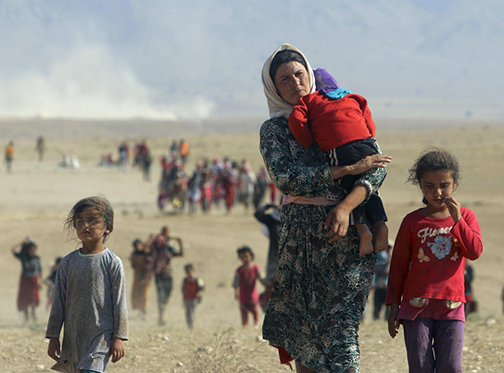
This passage in Isaiah involves some of the same geographies that are in the news today: Iraq, Israel, and Iran. Iraq roughly correlates with the ancient nation of Babylon. In 597 BC, King Nebuchadnezzar II of Babylon invades Judah — the remaining southern kingdom of Israel that hadn’t yet fallen. Judah becomes an occupied territory. Ten years later the inhabitants of Judah start a revolution — and lose. The revolt is squelched by the overwhelming military power of Babylon, and Jerusalem along with other towns and villages is leveled. There is much archaeological evidence for this destruction, as well as ancient Babylonian writings of this conquest.
As part of the defeat, many of the leaders and prominent citizens of Judah are forcefully relocated to Babylon — a method of exerting political control. Thousands of Israelites are exiled to Babylon — up to 25% of the population.
For the people of Judah, this was a time of intense struggle and difficulty. Core identity issues came into play: how could they maintain their identity in a foreign land—and without the temple of Jerusalem?
Some of our most famous Bible stories take place at this time: Daniel subsisting on vegetables while becoming stronger than other trainees; Daniel in the lions den; Shadrach, Meshach and Abednego thrown into the fiery furnace. These were marginalized foreigners living under a repressive government, and religious persecution to the point of death. “By the waters of Babylon, we sat down and wept for thee, Zion.” Psalm 137 is a song that came out of the Babylonian exile. We can take up these words of lament today to give voice to our own experiences.
In 539 BC, Cyrus the Great of Persia defeats Babylon, and the exiles of Judah are allowed to return home — to a homeland that has been destroyed — yet full of joy to be home.
And into this homecoming, the words of Isaiah say:
The Lord God’s spirit is upon me,
because the Lord has anointed me.
He has sent me
to bring good news to the poor,
to bind up the brokenhearted,
to proclaim release for captives,
and liberation for prisoners,
to proclaim the year of the Lord’s favor
and a day of vindication for our God,
to comfort all who mourn,
to provide for Zion’s mourners,
to give them a crown in place of ashes,
oil of joy in place of mourning,
a mantle of praise in place of discouragement.
For those who have been in exile, God has good news. And Jesus repeats these words during his ministry several centuries later, telling people that He is the fulfillment of these words. He ushers in a radical and new social order. An order held together by love, mutual provisioning, forgiveness, healing, the nonviolent settling of difference, and new kinship relationships that transcend bloodlines. This is Good News. And this is the work of God. It remains good news for us today.
Hear more of Rob’s advent words, and a current example of those in exile, via the video or audio linked below.
.
.
.
.


 Pasadena Mennonite Church